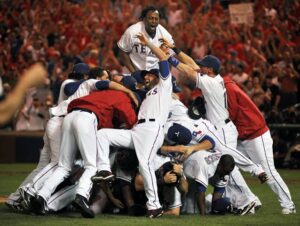
What does it take to become a campus legend before stepping onto a professional field? It’s not just about good stats. We’re talking about college baseball careers that rewrite records and get jerseys retired.
Forget the quiet players. We’re focusing on the giants. Brooks Kieschnick, for example, was a two-way star who dominated from both sides. He even won the Dick Howser Trophy twice. That’s not just talent; it’s a strategic lesson in being a dual-threat.
Then there’s Roger Clemens. His 1983 season was a pitching masterclass. It set the stage for his legendary career. These athletes didn’t just play; they defined the game, with ERAs and win-loss records that seem unbelievable.
This is about building a legacy. It’s about the numbers, awards, and moments that make players campus deities. For more on Texas baseball champions, the path from prospect to legend is a story of dominance.
Path to the Pros
For a college baseball star, the NCAA championship is just the start. The real excitement comes when the MLB Draft arrives. This is when a player’s dream is matched with a big price tag.
It’s the moment they move from college to the pros. But this step is just the beginning of a tough journey. It’s a path filled with challenges that only the best can overcome.
The draft is like a high-stress job interview on TV. Players wait anxiously in the green room, hoping to be picked. Some, like Burt Hooton, make it look easy. Drafted 2nd overall in 1971, Hooton threw a no-hitter in his fourth game. That’s not just a debut; it’s a statement to the world.
But for every Hooton, there are many others with more complex stories. The draft is a tough competition. It shows how far a player can go from college to the pros.
| Player | College | Draft Year & Pick | MLB Career Summary |
|---|---|---|---|
| Burt Hooton | Texas | 1971, 2nd Overall | 15-year MLB pitcher, 1972 NL Rookie of the Year, 2x All-Star |
| Greg Swindell | Texas | 1986, 1st Overall | 17-year MLB career, 3.86 ERA, 1995 World Series champion |
| Roger Clemens | Texas | 1983, 19th Overall | 7x Cy Young, 7x All-Star, 7x ERA title. The late-first-rounder who became a legend. |
| Taylor Jungmann | Texas | 2011, 12th Overall | Rapid MLB debut, but a career derailed by injuries. |
| Drew Stubbs | Texas | 2006, 8th Overall | Solid 10-year MLB career, but never an All-Star, traded multiple times. |
What makes a player a legend? It’s not just the speed of their fastball. It’s about adapting to new pitches and situations. A college star must learn to succeed in the big leagues, where everything is different.
The minor leagues are a tough test. They teach players patience and how to adjust. It’s about mastering new skills and overcoming weaknesses.
The signing bonus is exciting, but it’s just the beginning. The real challenge is the daily grind of the minor leagues. It’s a place where every detail is analyzed, from exit velocity to spin rate. This is the true path to the pros, filled with challenges and opportunities.
Impact on the Local College and Pro Scene
Wyatt Langford, a star from the Florida Gators, became a Texas Rangers MLB rookie known for walk-off grand slams. His success does more than win games. It changes the game for local colleges and pros.
For the University of Texas, the effect is quick. Winning games is a powerful draw. MLB stars like Langford are key in attracting top talent. The Longhorns are now seen as a path to the pros.
This creates a cycle of success. The NIL world gets a boost when a program shows pro success. MLB stars from Austin are the best example. Their success helps attract more talent, filling stadiums and raising funds.
This success isn’t just about winning. It’s about money. Alumni success boosts local businesses and the program’s value. The legacy of stars like Huston Street or Roger Clemens is seen in more applications and stadium upgrades. It also leads to multi-million dollar TV deals.