No state on the map worships baseball harder than Texas. Sit with that. The most diamond-obsessed corner of the country won’t let you legally lay a dollar on the game it loves. Football gets the Friday night lights, the documentaries, the prayer circles. The myth runs deep here.
The myth is also a lie. Strip away the helmets and the marching bands, and you find a state built on red dirt and a 162-game grind. Look at the massive action driving sports betting in Texas on any given summer night. Two World Series banners. A minor league empire baking in the sun. College programs bleed into Omaha every June. Add all of that up and you’ve got a state that bleeds baseball.
10 Reasons Texas Isn’t Just Football Country Anymore: It’s the Beating Heart of American Baseball
Spend one summer evening in a packed Texas ballpark and the argument dies on your tongue. The crack of the bat cuts through the swelter. Thirty thousand fans lean in on a full count. Kids race down concrete ramps chasing a foul ball. This is no side dish to football. It’s the main course, served fresh every day for six straight months. So before you hand the crown to the gridiron, look hard at what really runs this state. Ten reasons. Let’s go.
1. Two Big-League Franchises, One Cold War
Most states beg for a single MLB club. Texas runs two, and they can’t stand each other.
The Houston Astros hold court at Daikin Park, the old Juice Box rebranded after the Japanese air-conditioning giant bought the name in 2025. Roof closes. Cool air pumps. The train still rolls in left field. Up the interstate, the Texas Rangers rule Globe Life Field in Arlington, a climate-controlled palace where summer never touches the players.
Two hundred forty miles separate them. Both swing in the American League. Both think they own the state.
That kind of split breeds tribes. You pick orange and navy, or you pick red and blue. There’s no neutral. Among the Texas MLB teams, this feud gives the whole state a daily pulse from April to October. Baseball in Texas comes with a built-in enemy. Few markets can say the same.
2. The Astros Built a Dynasty Nobody Could Ignore
Love them or loathe them, the Astros turned into a machine.
Titles in 2017 and 2022. Seven straight trips to the ALCS. A roster pipeline that kept spitting out stars long after the rebuild ended. They became the team you scheduled your October around.
That 2017 ring carries an asterisk in many minds, thanks to the trash-can banging and the sign-stealing fallout. Fans outside Houston turned the club into a cartoon villain. Inside the city, the boos only hardened the loyalty.
Here’s the genius of it. Villainy sells. A hated winner pulls more eyeballs than a likable loser ever will. Every road series turned into theater. Every playoff run drew the casual viewer who wanted to watch the bad guys lose.
The Astros gave Texas its first true baseball dynasty. They also gave the sport a reason to argue all summer long. Drama like that doesn’t fade. It compounds.
3. The Rangers Finally Got Their Ring
For five decades, the Rangers were Texas heartbreak in cleats.
Two crushing World Series losses in 2010 and 2011. One strike away in Game 6, then nothing. A franchise that seemed cursed to come close and crumble.
Then 2023 happened.
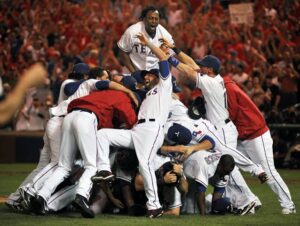
The Rangers ran the table on the road, knocked off everyone in their path, and brought home the first championship in club history. Arlington lost its mind. Grown men wept in the stands. The parade swallowed downtown whole.
You want emotional payoff? This was a generation’s worth of pain wiped clean in a single autumn. Kids who grew up watching Pudge and Pumpsie and a thousand near-misses finally saw the trophy lifted.
A first title hits different. It rewires a fan base. The Rangers stopped being the lovable losers and became champions, and the whole region felt the shift overnight. That moment alone answers the question of whether this place lives and dies with the diamond.
4. A Minor League Empire Hiding in the Heat
Want the real soul of baseball in Texas? Skip the big stadiums. Drive to the small ones.
The state runs one of the densest minor league networks in America. Cheap seats. Wild promotions. Future All-Stars you can watch for the price of a movie ticket. The names alone are worth the trip.
The Texas farm map
- Sugar Land Space Cowboys (Triple-A, Astros). Houston’s top prospects, one suburb over.
- Round Rock Express (Triple-A, Rangers). Nolan Ryan helped found the club. The legacy runs deep.
- Frisco RoughRiders (Double-A, Rangers). North Dallas baseball with a pool beyond the outfield wall.
- Corpus Christi Hooks (Double-A, Astros). Bayfront ballpark, salt air, raw talent.
- San Antonio Missions (Double-A). One of the oldest names in the minors, still grinding.
- Amarillo Sod Poodles and Midland RockHounds, baking on the high plains and out west.
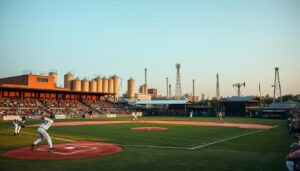
These are the Texas minor league baseball stadiums where the next wave gets forged. Hot dogs. Fireworks. A foul ball off the press box. This is the glorious, sweat-soaked weirdness of the sport at its purest, played for crowds who know every guy chasing a call-up by name.
5. College Baseball Here Is a Religion
June belongs to college baseball in Texas, and the state sends its sons to Omaha like clockwork.
Start with the Texas Longhorns, owners of more College World Series trips than almost anyone alive, now swinging in the brutal SEC. Then the Texas A&M Aggies, who clawed their way to the national championship series in 2024 and turned College Station into a baseball pressure cooker.
Omaha runs through the Lone Star State
- TCU in Fort Worth, a steady Omaha regular with a swagger to match.
- Rice in Houston, the 2003 national champions who proved a smaller school could rule the country.
- Houston, Texas Tech, and Dallas Baptist, all programs that recruit hard and win harder.
Friday nights in spring fill these parks. Students storm the field after walk-off wins. Pro scouts crowd the seats with radar guns. The best college baseball teams in Texas don’t just develop draft picks. They build the fever that carries the sport from one generation to the next. Football may own the fall. The diamond owns the back half of the school year.
6. The Talent Pipeline Never Dries Up
Texas grows ballplayers like it grows oil. Drill anywhere and you hit talent.
Nolan Ryan came out of Alvin, a fireballer who threw seven no-hitters and never quit. Roger Clemens sharpened his game in Houston before terrorizing hitters for two decades. Josh Beckett rose out of Spring and won a World Series MVP as a kid.
The factory never closed. Travel ball runs year-round. High school programs draw scouts by the dozen. Showcases pack stadiums in the dead of summer with thirteen-year-olds throwing gas.
So why does this state keep producing big leaguers? Volume and weather and obsession, stacked on top of each other. More kids play more innings here than almost anywhere. The cream rises fast.
Every spring, the MLB draft pulls another crop of Texas arms and bats into the pros. The pipeline feeds itself. That’s not luck. That’s a culture doing what it does best.
7. The Ballparks Are Cathedrals With Air Conditioning
Texas heat would melt a normal baseball season. So the state built sanctuaries to beat it.
Daikin Park in Houston keeps the retractable roof and the quirks: the hill that used to live in center, the short porch, the locomotive that chugs after every home run. Globe Life Field in Arlington went all the way, sealing the roof and pumping cool air so no fan ever sweats through a July doubleheader.
These parks pack out. Families fill the concourses. Vendors hustle. The smell of grilled meat hangs over every section.
A ballpark in Texas isn’t a building. It’s a gathering place, a refuge from the swelter, a spot where strangers high-five over a stolen base. Worship needs a temple. Baseball here got two of the best in the league.
8. The Summer Never Stops the Game
Up north, snow ends the season early. Kids hang up the glove for months.
Not here.
Texas plays nearly year-round. Mild winters mean travel teams keep swinging in January. Spring stretches long. Fall ball picks up the slack. A kid in this state can log more innings by age sixteen than a kid in Minnesota logs by twenty.
That endless calendar builds reps. Reps build skill. Skill builds the deepest amateur baseball culture in the country.
Long summers turn the sport into a daily habit, not a seasonal hobby. The diamond stays open. The bats keep cracking. And the love only grows with every sun-scorched afternoon spent chasing fly balls in 95-degree air.
9. The Lone Star Series Is a Blood Feud
Astros versus Rangers stopped being a friendly rivalry years ago.
The 2023 ALCS lit the fuse for good. Texas knocked off Houston in seven games on the road, then rode that momentum to the title. Houston has never forgotten it. Neither has Arlington.
Now every meeting carries weight. Hard slides. Stare-downs. Bullpens jawing across the field. Two fan bases that share a state and share zero love.
A rivalry like this proves a market has arrived. You don’t get blood feuds in places that shrug at baseball. You get them where the sport matters enough to break friendships and split families down the middle. The Lone Star Series delivers that venom twice a year, minimum, with the playoffs always lurking as a tiebreaker.
10. The Heat Weeds Out the Weak
Play a full season in this state and you learn what you’re made of.
One hundred and sixty-two games. Triple-digit afternoons. Humidity thick enough to chew. Doubleheaders that start in furnace air and end under stadium lights with your jersey soaked through.
A soft player breaks here. The grind exposes him fast.
What survives is tougher. Leaner. Built for the long haul. Texas baseball forges a different kind of athlete, one who treats August like a test and shows up anyway. The sun decides who stays.
That’s the unglamorous truth football fans skip. The gridiron gives you sixteen Sundays. The diamond gives you a daily war with the calendar and the climate. Only the durable last. This state has been minting durable ballplayers for a hundred years.
The Bottom Line
Football owns the legend. The diamond owns the long summer, and in Texas the long summer is close to a religion.
Two champions. A farm system stretched across the map. College programs storming Omaha. A talent factory that never shuts down. Add it up and the verdict writes itself. This is a baseball state, full stop.
FAQs
Is Texas a baseball state or a football state? Both, honestly. Football owns the mythology and the Friday night crowds. Baseball owns the depth: two MLB clubs, a loaded minor league system, elite college programs, and a youth pipeline that never quits. Year-round, the diamond runs the show.
Why is baseball so popular in Texas? Mild winters let kids play nearly all twelve months, so reps pile up early. Stack that on two big-league franchises, a dense farm network, and college teams that reach Omaha, and you get a culture obsessed with the sport from travel ball straight through the pros.
What are the best college baseball teams in Texas? Texas, Texas A&M, TCU, Rice, Houston, Texas Tech, and Dallas Baptist all carry serious weight. Texas and TCU are Omaha regulars, Rice won it all in 2003, and A&M reached the national title series in 2024.
Where can I watch Texas minor league baseball? Plenty of options. Catch the Sugar Land Space Cowboys, Round Rock Express, Frisco RoughRiders, Corpus Christi Hooks, San Antonio Missions, Amarillo Sod Poodles, or Midland RockHounds. Cheap tickets, wild promo nights, and future big leaguers at every stop.Can I legally bet on Texas baseball right now? No. Sportsbooks remain illegal statewide. Daily fantasy sports apps are the legal play for now, and the next shot at legalizing wagering comes in the 2027 session.