What is the sound of a 162-game season? It’s not just the bat crack or crowd roar. It’s the voice in the silence, telling stories between pitches. Modern sports broadcasters are not just calling games; they’re crafting stories that turn ordinary nights into legendary events.
This isn’t just play-by-play. It’s the magic of the broadcast booth, where voices are both journalists and bards. Storytelling reigns supreme, as Ryan Urquhart notes. The booth’s chemistry, as Chris Caray stresses, is as vital as the lineup card. Mike Ferrin’s “stat wonk” passion shows the deep, analytical love for the game’s data.
The broadcaster is the narrator, color commentator, and entertainer, spinning a three-hour tale where the climax is always in doubt.
How do you fill a 162-game season with meaning? The answer is in this unique craft. Legendary radio hosts and today’s radio hosts know this. They see the first radio broadcast of a baseball game as the start of a new kind of storyteller.
They’re not just calling pitches; they’re weaving a narrative through the game’s slow, strategic moments.
To be more than a narrator, one must become part of the game’s fabric. Every anecdote, statistic, and moment of silence adds to the season’s portrait. This is the craft of the modern broadcaster: a storyteller in the booth, turning each inning into an epic tale.
Role in Shaping Baseball Culture
We often focus on the players, but the game’s true soul is the voice behind it. Broadcasting and sports journalists are more than narrators. They shape the sport’s culture. They don’t just talk about a fastball; they tell a story of rivalry, comeback, and hope.
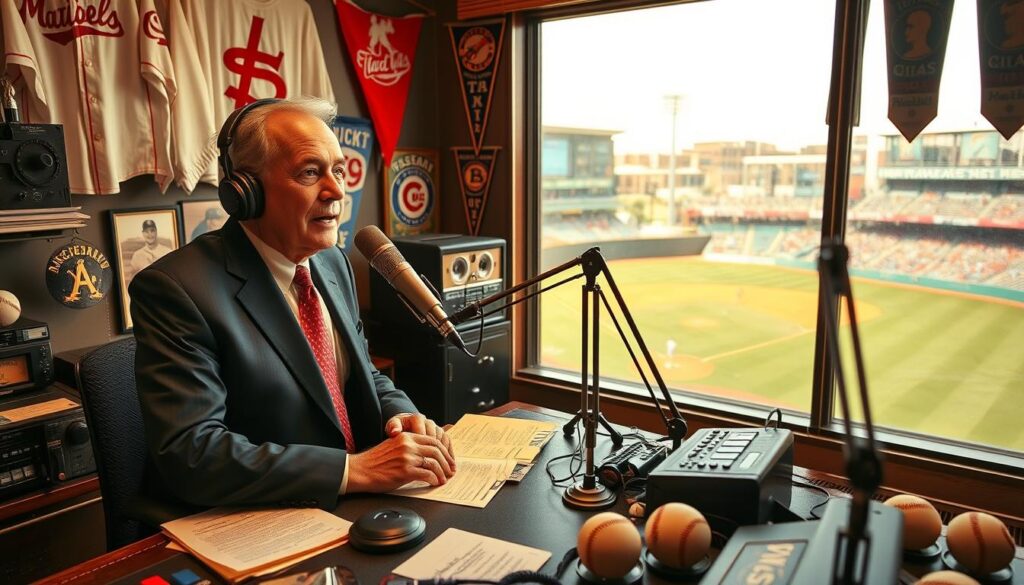
George W. White, a legendary Texas writer, didn’t just report on the Dallas Steers. He helped create their legend. His stories, filled with history and connections to stars like Babe Ruth, defined the team’s identity. He didn’t just report; he shaped the culture of the game.
From the Typewriter to the Teleprompter: Evolving Voices
The art of calling a game has changed, but its core remains the same. Today’s broadcasters use new tools to tell the story. They blend old-school storytelling with modern data and a conversational style.
This change is key for the sport’s future. It’s important for all voices to be heard. A recent piece on diversity in baseball’s broadcast shows the need for more voices. True cultural representation is the next step in storytelling.
The table below shows how broadcasters have evolved from myth-makers to multi-platform storytellers.
| Era | Primary Medium | Key Traits | Cultural Impact |
|---|---|---|---|
| Old-School Chroniclers (e.g., George W. White) | Radio, Print, Early TV | Story-focused, myth-making, local authority. | Built team and city identity; created local legends. |
| Modern Broadcasters (e.g., modern PBP teams) | TV, Digital, Social Media | Analytical, data-informed, interactive. | Demystifies the game with stats, connects via social media, curates highlights. |
| Sports Journalists (Beat Writers, Columnists) | Newspapers, Digital Media | Investigative, analytical, providing critical context. | Hold teams accountable, provide off-field narratives and deep analysis. |
This isn’t just play-by-play; it’s a form of cultural anthropology. The broadcaster and the sports journalist connect the event to the audience. They make a rookie’s first hit meaningful within a team’s history. They explain a bunt as a nod to the past.
In the end, the greats are not the story; they’re its best narrator. They don’t just call the game; they narrate the culture around it, season after season.
Most Memorable Calls
Great baseball calls don’t just describe a moment; they become the permanent audio track for our collective memory. In the broadcasting booth, the alchemy of preparation, emotional intelligence, and perfect timing transforms a play-by-play into a cultural artifact. It’s not merely announcing; it’s the art of bottling the raw, electric chaos of a historic play and distilling it into a narrative that lasts for generations.
Consider the list of legendary World Series voices: from Mel Allen’s “How about that!” to Joe Buck’s “The Cubs… have won the World Series!” Each name—Scully, Buck, Gowdy, Michaels—represents a lineage of storytellers. The magic isn’t just in the “what,” but the “how.” The anatomy of a great call is a study in craft.
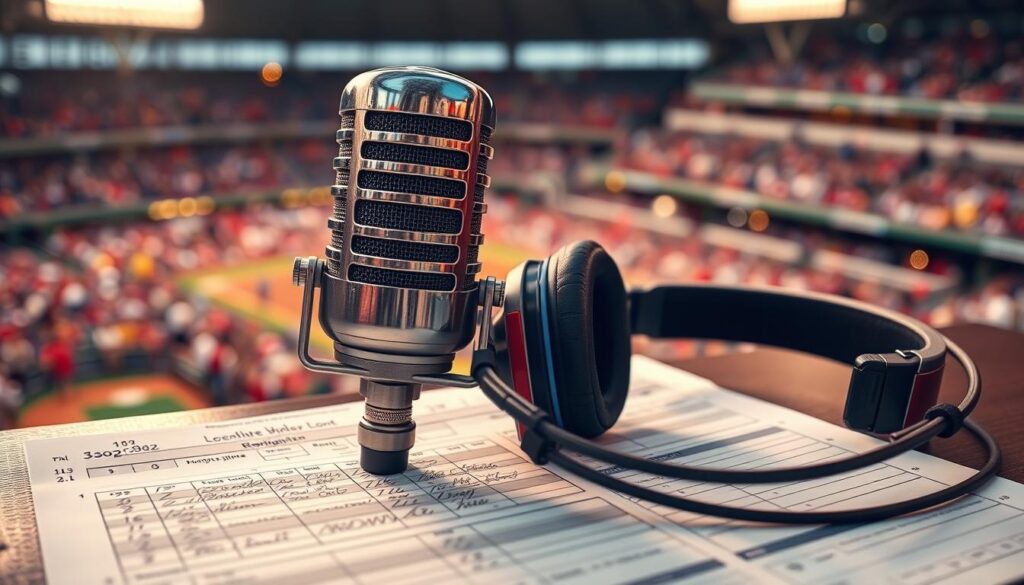
What separates a good call from an immortal one? It’s the broadcaster’s alchemy of preparation and instinct. Vin Scully, for instance, was a master of the pregnant pause, letting the crowd’s roar tell the story after Kirk Gibson’s 1988 World Series homer. This wasn’t improvisation; it was the culmination of a career spent learning when to be the narrator and when to let the moment speak for itself. As he detailed in his Fordham Magazine interview, his approach was less about the call and more about the context, the human story. That’s the broadcasting secret: the call is the climax, but the preparation is the story.
The table below dissects a few iconic calls, breaking down the broadcaster’s toolkit that transformed a great moment into an immortal one.
| Broadcaster | Iconic Call | Year | The “It” Factor |
|---|---|---|---|
| Jack Buck | “Go crazy, folks! Go crazy!” (Ozzie Smith’s 1985 NLCS walk-off) | 1985 | Unscripted, raw, and perfectly captured the stadium’s pandemonium. |
| Joe Buck | “The Cubs… have won the World Series!” | 2016 | Historic weight, delivered with a perfect mix of awe and historical gravity. |
| Vin Scully | “In a year that has been so improbable, the impossible has happened!” | 1988 | Perfect blend of poetic language and perfect silence before the call. |
| Al Michaels | “Do you believe in miracles? YES!” | 1980 | Transcended sports; became a cultural touchstone for underdog triumph. |
The anatomy of a legendary call has three parts. First, the foundation: the broadcaster’s scorebook is a bible of stats and anecdotes, the fuel for context. Second, the instinct: knowing when to let the ambient sound of 50,000 people tell the story. The greats, like Scully, understood that silence can be more powerful than words.
Third, the word. It’s not about a thesaurus of synonyms for “home run.” It’s about the one, perfect, simple phrase that becomes a proper noun: “The Shot Heard ‘Round the World,” “The Flip,” “The Flip Play.”
This is where the art of broadcasting transcends play-by-play. It’s a form of historical documentation. When we hear the crack of the bat and the voice of the broadcaster, we’re not just hearing a call. We’re hearing history being narrated in real-time. The broadcasting booth isn’t just a seat with a microphone; it’s the narrator’s perch for the grand, ongoing story of the game.
Ultimately, the magic of broadcasting lies in this alchemy. It’s the fusion of a sharp, prepared mind with the emotional intelligence to get out of the moment’s way. The best calls aren’t just descriptions; they’re the emotional and historical context, delivered in real-time. They don’t just tell you what happened; they tell you why it mattered. That’s the alchemy of a great call: it freezes a moment in time, gives it a voice, and lets it echo forever in the collective memory of the game.
Preservation of History
The final moment in the booth isn’t when the game ends. It’s when the broadcaster stops talking and starts saving history. They become the first to write history, moving from telling the story to saving it. The score, stats, and calls are not just moments. They are the key pieces of history.
Vin Scully wasn’t just calling a game; he was saving history. We, the listeners, are the witnesses to these moments. The voice in the booth is our historian. They are the true history keepers, making sure every moment is remembered for years.
This need to save history is growing stronger. Places like the Indiana Broadcast History Archive at IU Bloomington are leading the way. They collect the raw materials of our past, like audio and video tapes. It shows that the play-by-play is a vital document.
So, when you hear a call, listen for the history it holds. Great broadcasters were not just announcers; they were the first to write history. The game may end, but the call lives on. That’s the final, most important play in the book.