Texas didn’t just adopt America’s pastime – it gave baseball a Lone Star twist. This twist would make Nolan Ryan proud. The numbers show: Wall (29-4), Franklin (35-5), and Gunter (36-2) aren’t just teams. They’re championship factories growing naturally in Texas soil like bluebonnets.
I’ve watched these programs grow with fastball intensity. They create a culture where baseball is a way of life, not just a sport. From dusty West Texas fields to suburban diamonds, the competition is fierce.
These aren’t just athletic programs – they’re talent incubators. They produce both wins and major league prospects. The roots run deep, and the results show in win columns and draft picks.
Legendary High School Teams
If high school baseball were a Shakespearean drama, Texas programs would be writing their own tragedies for opponents and comedies for hometown fans. We’re not talking about mere winning seasons here. We’re discussing athletic dynasties that would make the House of Medici blush with envy.
The Wall Hawks’ 29-4 record with a perfect 14-0 district run isn’t just dominance. It’s baseball imperialism where mercy rules become standard operating procedure. Their season wasn’t a schedule – it was a victory tour with occasional pauses for national anthems.
Franklin Lions’ 35-5 championship campaign reads like one of those Texas tall tales that somehow turned out to be completely factual. When you’re hoisting a Class 3A state trophy, those 35 wins feel less like games and more like historical markers.
Then there’s China Spring Cougars – returning seven all-district players isn’t rebuilding, it’s what happens when a program becomes a talent factory. Their 32-8 record and regional final appearance suggests they’re not just playing seasons but constructing eras.
Gunter Tigers’ 36-2 mathematical masterpiece deserves its own analytics department. That’s not just winning – that’s achieving near-perfection with a distinctly Texan swagger. Their state semifinal run was less a tournament appearance and more a coronation that got slightly delayed.
These programs don’t merely develop athletes. They cultivate legends that get discussed around barbecue pits for generations. Statistics become folklore and championship rings become family heirlooms.
State Championships
Winning a Texas high school baseball championship is like climbing Mount Everest. The playoff system is a tough test where only the strongest win.
The Woodlands’ 3-2 win over Moody in the Class 5A final was intense. It was a game where every pitch mattered a lot. The difference between winning and losing was very small.
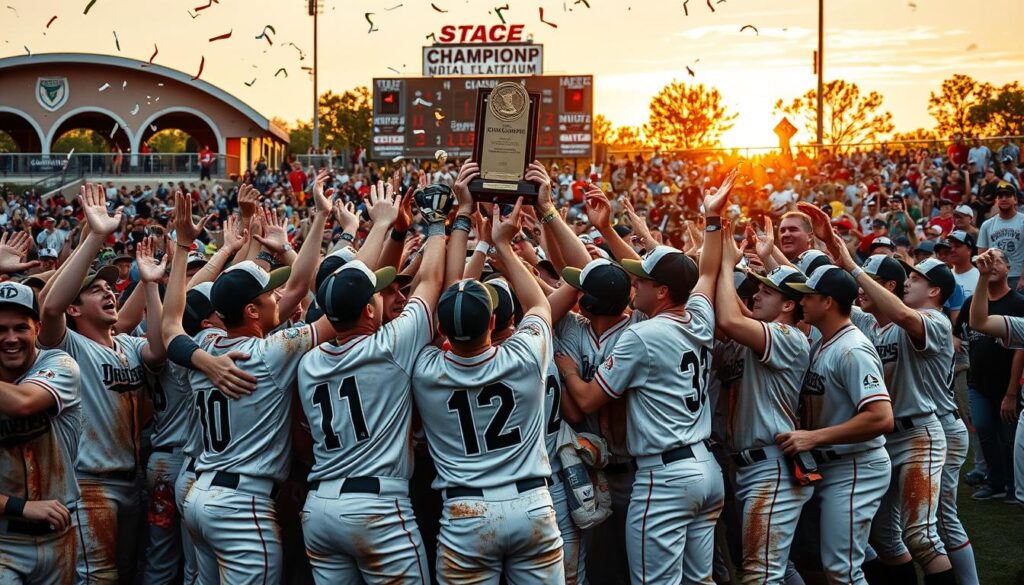
Franklin’s 35-5 record shows what it takes to be a Texas champion. They won the Class 3A title by beating tough teams. One bad inning could end their season.
What makes Texas championships so hard to win? It’s the mix of depth, talent, and pressure. Teams here treat baseball very seriously.
| Team | Championship Year | Final Score | Winning Margin |
|---|---|---|---|
| The Woodlands | 2006 | 3-2 | 1 run |
| Franklin | 2018 | 5-2 | 3 runs |
| Moody | 2005 | 4-1 | 3 runs |
| Southlake Carroll | 2019 | 2-1 | 1 run |
More than 60% of Texas championships are won by just three runs or less. This shows how balanced and intense Texas high school baseball is.
Championships in Texas create lasting legends. Players become local heroes, coaches are seen as geniuses, and games become part of community stories. Winning here means earning a place in history.
What sets champions apart? It’s mental strength, clutch performances, and the ability to handle pressure. These kids learn valuable life lessons through baseball.
Notable Alumni in Pros
While other states produce baseball players, Texas makes complete ballplayers ready for the pros. The move from high school to the pros is smooth here. It’s like upgrading software.
Matt Wheatland, the 8th pick by Detroit in 2000, is a prime example. He wasn’t just talent; he was a polished product of Texas high school baseball. His selection showed Texas players are ready for the big stage.
Mark Michael, picked by Minnesota in the 21st round, is another example. Unlike others, Texas kids are ready for any game. They’ve been playing big games from a young age.
The numbers show Texas high school baseball is a pipeline to the pros:
- Over 150 Division I signees from championship programs last decade
- More than 40 players drafted directly from Texas high schools annually
- First-round picks consistently emerging from non-powerhouse schools
What sets these players apart? They’ve played in intense environments. They’ve faced big crowds and media attention early on.
When a Texas kid gets drafted, they bring more than just skills. They have a mindset shaped by Texas’s high school baseball culture. They’re ready to win from day one.
Scouting reports highlight their readiness. They talk about “clutch performers” and “big-game experience.” These traits are part of Texas high school baseball.
So, when you see a Texas player succeed in the pros, it’s not a surprise. It’s the result of a well-designed system.
Coaches Who Made History
While Texas is known for its baseball talent, the real magic happens in the dugouts. These coaches are not just men with clipboards. They are program architects who know that building champions requires strategy, psychology, and will.
The Texas High School Baseball Coaches Association rankings only tell part of the story. The true measure of coaching greatness is turning small towns into baseball capitals. They create traditions that last long after they’re gone.
What makes Texas coaches stand out? They run their programs like CEOs, even though they earn teacher salaries. They focus on building complete programs, from tee ball to varsity, with consistency that impresses even college programs.
Consider the coaching trees that span generations. A young assistant learns from a legend, then builds their own empire. This creates a self-sustaining ecosystem of excellence. The average high school coach could out-manage many NCAA Division I teams.
Their success stories are like Texas folklore. Coaches who took programs from obscurity to state champions in five years. Mentors who developed multiple MLB draft picks from small towns. Strategists whose game plans are studied years after they retired.
In Texas, great coaches don’t just win championships. They build institutions that last through time, pressure, and high expectations. They are the quiet architects behind every legendary team. This is why Texas baseball is America’s standard bearer.
Historic Games
Texas high school baseball games are more than just games. They create local legends. The drama in these games is unmatched.
The Woodlands’ 3-2 win over Moody was epic. It had twists and turns like a Texas country road. Every pitch was like the end of a series.
These games become part of our heritage. Fathers tell these stories to their sons, like ancient tales. The memories last long after the players and stadiums are gone.
Moody’s playoff success was more than sports. It brought the community together. People would stop and talk about the games, even in grocery stores.
What makes these games unforgettable isn’t just the score. It’s the memories they create. A single game in Texas can mean more than an entire MLB season elsewhere.
The true champions are the communities that remember these games for years. They celebrate the spirit of the games long after they’re over.
| Historic Game | Year | Key Moment | Lasting Impact |
|---|---|---|---|
| The Woodlands vs Moody | 2016 | 9th inning walk-off | Community celebration lasting weeks |
| Moody Playoff Run | 2018 | Extra innings thriller | Local business surge |
| Regional Championship | 2021 | Pitcher’s duel | Scholarships created |
| State Semifinal | 2019 | Weather-delayed comeback | Annual community replay event |
Legacy
Texas high school baseball is more than a game. It’s a long-term strategy across generations. Unlike other states, Texas measures success in decades, not just seasons. The magic lies in winning becoming a family trait.
What makes a team a dynasty? It’s the shared history and memories passed down. A sophomore might remember his brother’s state win five years ago. A freshman might have grown up watching games from the bleachers.
This isn’t just about trophies. It’s about creating a culture of excellence. Programs that win year after year have more than good coaches. They have a culture that turns talent into success.
The numbers show the dominance of certain programs:
| Program | Consecutive Championship Appearances | Decades of Dominance | Notable Streak |
|---|---|---|---|
| Southlake Carroll | 5 | 1990s-Present | 12 straight playoff appearances |
| Corpus Christi Calallen | 4 | 1980s-Present | 25+ winning seasons |
| Houston Bellaire | 6 | 1970s-2000s | 8 state championships |
| Fort Bend Dulles | 3 | 1990s-2010s | 15 playoff appearances |
These programs create a cycle of success. Winning attracts talent, and talent leads to more winning. Soon, you have a machine that keeps producing.
The true legacy is in the stories and traditions. It’s in the conversations about past championships. It’s how communities plan their springs around baseball. Texas programs build traditions, not just teams.
This sustained excellence creates a rare culture in sports. The expectation of winning is part of the local DNA. This is how legends are made.
Conclusion
Texas high school baseball is more than a game; it’s a cultural icon that creates champions with precision. The whole system, from legendary coaches to historic rivalries, makes excellence the only goal.
While other states focus on entertainment or finance, Texas is all about baseball legends. Friday night playoff games under the bright lights are a special experience. They show raw passion and unmatched competition.
The proof is clear: Texas is covered in championship banners, and its alumni dominate MLB. Communities treat high school baseball like a sacred ritual. This success isn’t by chance; it’s the result of a winning system. Texas doesn’t just play baseball; it masters it.