Let’s drop a truth bomb right from the first pitch. When you talk about America’s collegiate diamond traditions, you’re really talking about one program that defines excellence.
Founded back in 1894—before the forward pass was even legal in football—this institution didn’t just join the conversation. It started the whole damn discussion.
With a .723 winning percentage that would make the ’27 Yankees blush, we’re looking at Hemingway-level efficiency. They’re economical with losses and prolific with victories.
Six national championships. Thirty-eight College World Series appearances. This isn’t just history—it’s a masterclass in sustained athletic superiority that continues to dominate today.
The Longhorns’ Dominance
Let’s be clear about something: when we talk college baseball royalty, Texas is the king. They’re not just in the conversation; they’re the ones holding the microphone.
Thirty-eight College World Series appearances? That’s not a streak; that’s institutional memory. Texas treats the CWS like their second home address. They’ve basically got their own parking space at TD Ameritrade Park.
Six national championships from 1949 to 2005 show generational excellence. But what really sets Texas apart is their consistency. Two hundred fifty-eight NCAA tournament wins across 63 appearances is statistically absurd.
Think about that number for a second. Two hundred fifty-eight wins. That’s more victories than most programs have games. It’s the kind of sustained success that makes you wonder if Texas has discovered some secret algorithm for winning.
Their 88 College World Series wins represent something deeper than numbers. Each win is a chapter in a legacy where the Longhorns aren’t just participants—they’re architects of the sport’s history.
What makes this dominance so remarkable? It’s the combination of peak performance and relentless consistency. Texas doesn’t just have great seasons; they have great decades. They’ve been competing at the highest level for generations.
This isn’t a program that rebuilds—it reloads. While other teams celebrate making the tournament, Texas measures success by how deep they go in Omaha. It’s a different standard entirely, one built on six national titles and a culture that expects excellence.
The numbers don’t lie, but they also don’t tell the whole story. Behind those 38 CWS appearances lies a tradition of excellence that’s become the gold standard in college baseball. When other programs look for models of sustained success, they all look to Austin.
Breakout Moments by Decade
Texas baseball didn’t just win championships—it redefined excellence across generations. Each decade brought a unique flavor of dominance, like different vintages from the same legendary vineyard.
The 1940s saw Texas’s first national championship in 1949. This wasn’t just winning—it was setting a blueprint. Coach Bibb Falk built a program that valued fundamentals over flash, creating a foundation for future success.
Then came the 1950s, when Texas decided winning once wasn’t enough. Back-to-back championships in 1949-1950? That’s like ordering two steaks when one would do. This era made the Longhorns college baseball’s first true dynasty.
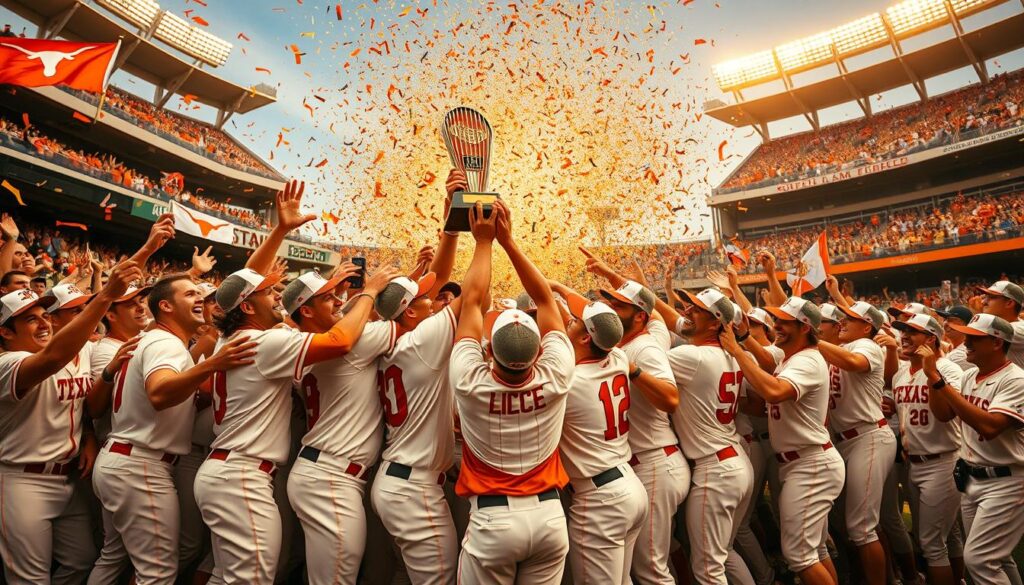
The 1970s and 1980s saw Cliff Gustafson’s machine at peak efficiency. Between oil booms and big hair, Texas collected championships in 1975 and 1983. Gustafson’s teams played with surgical precision—they didn’t beat you; they dismantled you.
Then the 2000s arrived saying “hold my Shiner Bock” and delivered two more titles for good measure. Augie Garrido’s 2002 and 2005 squads combined strategic brilliance with raw talent. They didn’t just win games; they staged comebacks that felt like political upsets.
| Decade | Championships | Defining Characteristic | Lasting Impact |
|---|---|---|---|
| 1940s | 1 | Fundamental Excellence | Blueprint for success |
| 1950s | 1 | Back-to-Back Dominance | Establishing dynasty status |
| 1970s | 1 | Surgical Precision | Modern player development |
| 1980s | 1 | Strategic Innovation | Advanced scouting systems |
| 2000s | 2 | Comeback Brilliance | Mental toughness standard |
What makes these champions special isn’t just the trophies. It’s how each era adapted excellence to its time. The Disch years valued fundamentals. The Gustafson era perfected execution. Garrido’s teams mastered the mental game.
Texas baseball proves that champions aren’t born—they’re built across decades. Each championship team added another layer to the legend. They didn’t just win games; they wrote chapters in college baseball’s history book.
Legendary Coaches
Did you know the Texas Longhorns baseball program has only had four full-time coaches in 105 years? That’s not just stability—it’s a family heirloom of genius.
Billy Disch (1911-1939) started with the strategic mind of a chess grandmaster. Bibb Falk (1940-1967) then built a winning machine that would impress today’s analysts.
Cliff Gustafson ruled for 29 years (1968-1996), showing what sustained excellence looks like. Augie Garrido (1997-2016) followed, blending West Coast wisdom with Texas grit.
Each coach saw themselves as caretakers of a timeless legacy. They didn’t just win games—they built a lasting legacy.
The Texas Longhorns coaching tree is about adding to, not replacing, the past. It’s about building on their ideas and adding your own touch.
From Disch’s basics to Garrido’s dynasty, these coaches showed that great programs are inherited and grown.
Player Spotlights
Let’s talk about what makes Texas stand out in college baseball. It’s not just about finding talent. The Longhorns create stars in the Austin heat.
Take Roger Clemens. He didn’t just pitch at Texas; he changed the game. His 1983 season was a masterclass in intimidation. His fastballs were unstoppable, and his competitive fire was unmatched.
Huston Street is another legend. He didn’t just save games; he wrote the final chapters. His 2005 championship performance was unforgettable. It showed his clutch gene, making scouts and opponents alike take notice.
But Texas doesn’t just create one-off wonders. They produce a line of major league talent. Here’s a list of Longhorn legends:
- Calvin Schiraldi – World Series champion
- Burt Hooton – No-hitter maestro
- Keith Moreland – RBI machine
- Spike Owen – Defensive wizard
- Mark Petkovsek – Control artist
- Greg Swindell – Strikeout king
- Brandon Belt – Power hitter extraordinaire
What ties them together? Development. Texas takes raw talent and turns it into major league stars. They teach players to win, not just to throw harder or hit farther.
The proof is in the pinstripes. How many college baseball programs have multiple Cy Young winners? World Series MVPs? All-Stars across decades? Texas doesn’t just compete; they create legends.
Even today, the tradition lives on. Players like Kody Clemens carry the torch of excellence. The Longhorns reload with players who know what it means to wear burnt orange.
So, when you watch Texas college baseball, you’re seeing more than a game. You’re watching a finishing school for future stars. And the rest of the NCAA should definitely take notes.
Rivalries
The hiring of Jim Schlossnagle was more than just a move. It was a strategic step in Texas’ rivalry game. Taking A&M’s coach? That’s not just recruitment; it’s a form of psychological warfare.
Texas baseball rivalries are more than games. They’re cultural events that shape legends and expose weaknesses. The Longhorns challenge entire programs, pushing them to their limits.
The Southwest Conference battles were more than games. They were tests of character under pressure. The rivalry between Texas and Texas A&M defined both programs.
When Texas joined the Big 12, rivalries intensified. Oklahoma faced Texas’ baseball dominance, adding to their football woes. Other teams realized facing Texas was a test of their own limits.
What makes Texas unique? They set their own standards and challenge rivals to meet them. It’s a clever strategy that would impress Machiavelli.
The greatest trick Texas pulled? Making opponents think they’re competing for victory, while Texas aims for legacy. True champions know that rivalry games reveal character more than championships do.
| Rival | Historical Significance | Key Competitive Elements | Texas Advantage |
|---|---|---|---|
| Texas A&M | In-state recruiting battles | Conference dominance | 6 National Championships |
| Oklahoma | Cross-sport rivalry extension | Big 12 supremacy | Consistent postseason success |
| Baylor | Historic SWC competition | Regional recruiting | Superior facilities |
| TCU | Modern conference alignment | Pitching development | Larger fan base |
These rivalries create a constant measuring stick. Texas sets the standard, and others chase it. It’s a beautiful cycle of excellence.
The Schlossnagle move is a perfect example. Texas doesn’t just beat rivals; they absorb their strengths. It’s like buying the competition’s best ideas.
Rivalry games reveal character. How teams perform against Texas tells us more than any trophy. The Longhorns push everyone to show their best and worst.
This makes champions through adversity. Texas players know every game is a chance to leave a legacy. They’re not just playing; they’re defending a standard that elevates everyone.
Ongoing Traditions
If college baseball were a religion, the Texas Longhorns would be in charge. Their traditions are more than just fun—they’re what make players into champions. They’re like a system that always works.
UFCU Disch-Falk Field is at the heart of this system. It’s a place where players face high expectations. The seats, painted burnt orange, watch players with 7,373 critical eyes, expecting nothing but the best.
The Hook ’em Horns sign is more than a gesture. When a Texas Longhorns player shows it, they’re claiming victory. It’s like saying, “This is our place.”
The burnt orange is more than a color—it’s a symbol of strength. It warns opponents of the team’s power. The white accents add clarity to the team’s fierce spirit.
These traditions build a lasting memory for the team. Each new generation gets the wisdom of past successes. This is why they play with such intensity, like in their annual fall World Series intra-squad event.
The team’s pregame routines are not just habits. They’re rituals that prepare players for success. Each step is designed to focus their minds.
After games, the team celebrates and starts fresh. The handshake line helps players switch from competition to teamwork. Singing “The Eyes of Texas” unites them, reminding them of their shared goals.
The Texas Longhorns traditions work because they stay the same over time. Players add to the tradition with each win. This builds a legacy for future teams.
These traditions are not just about honoring the past. They’re a key to success. The Texas Longhorns know that traditions shape the future.
In a world where athletes come and go, these traditions keep the team strong. They make the Texas Longhorns reload, not rebuild. The team’s traditions keep it running smoothly.
Conclusion
Texas Longhorns baseball is more than a team. It’s a model for lasting success. With six national titles and 38 College World Series trips, they’ve created a lasting legacy.
Their record speaks volumes. They have a .723 winning percentage and are second in wins. They’ve won 80 regular-season conference titles and 16 tournament championships. These numbers show a winning culture.
Even in recent years, they’ve kept up the high standards. The 2025 Texas Longhorns baseball team won the SEC regular season title. Players like Max Belyeu and Jalin Flores led the way.
Great college baseball programs are rare. True champions build lasting systems. Texas doesn’t follow trends; it sets them. That’s why they’re a model in college baseball and beyond.