Forget the roar of a modern crowd. Let’s talk about the ghosts in the box scores.
My search began with a single, misspelled name in a dusty 1896 ledger: “Countryman.” Who was he? This wasn’t a quest for Cooperstown, but for the muddier, more human origins of the game here. It’s a world where the records are fragments and the stories are written in scandal and storm.
The 19th-century baseball scene was pure chaos. A team could vanish in a tornado. A bank president might be your cleanup hitter. This is where myth meets the municipal archive.
And that’s how I found Elmer Countryman. By the stats, a pitcher for Sherman. By reality, a tragic figure straight out of a Edwin Arlington Robinson poem—a man “rich – yes, richer than a king” in Illinois, but a mere footnote in Texas sports history.
His story is our entry point. This is where the state’s baseball narrative begins not with a legend, but with a whispered debate over a scribe’s error.
Key Figures and Teams
Three men, each with a unique path, shared a common goal: they were the first Texas pioneers in professional baseball. The Texas League’s start wasn’t thanks to one hero. Instead, it was a group of bankers, hustlers, and local dreams.
Meet Elmer J. Countryman, a banker who also pitched for the 1896 Sherman/Paris team. Baseball was just a side gig for him. He was a true “gentleman amateur,” a rare breed today.
Pete Weckbecker was the opposite of Countryman. He was the team’s player-manager in 1897 and was known for his bold moves. He even tried to scam a town for $250. His later years were spent in a veterans’ hospital.
Otto McIver was born in Texas and played for the St. Louis Cardinals. He then spent nearly 20 years in the Texas League. He was the local hero who almost made it big.
These Texas pioneers did more than play baseball. They shaped the game’s early spirit. Countryman brought class, Weckbecker ambition, and McIver local talent.
Their teams were as colorful as they were. The Sherman Students, Paris, and Galveston teams were more like traveling shows. Games were community events, business chances, and sometimes scams.
| Player | Primary Role | Archetype | Defining Trait | Lasting Legacy |
|---|---|---|---|---|
| Elmer J. Countryman | Banker/Pitcher | The Gentleman Amateur | Respectability & Capital | Bridged business and sport |
| Pete Weckbecker | Player-Manager | The Hustler | Shrewd (often controversial) tactics | Showed baseball’s raw, competitive edge |
| Otto McIver | Outfielder | The Hometown Hero | Local talent development | Proved Texas could grow its own stars |
What united them? Their drive, but in different ways. Countryman used baseball for networking. Weckbecker for survival. McIver for his dream. Together, they made the league exciting.
Their tales reveal the true nature of early baseball. It was about money, reputation, and community pride. Remember these pioneers when you think of Texas Legends today.
They weren’t always noble or successful. But they were always captivating. That’s the lasting impact of the original Texas pioneers who started the game in Texas.
Their Impact on Local Communities
Baseball in the 1800s was more than a game in small-town Texas. It was a test of community values. Players had to fit in, not just play well.
Frank “Country” Countryman was a prime example. He was praised for being humble and fitting in. This was key to his success in Paris, Texas.
Countryman’s influence didn’t end with baseball. He became a leader in Dixon, Illinois. His past helped him in business and community roles.
But, when his bank failed, the town’s trust was broken. This showed how deeply baseball was tied to community life.
Charlie Weckbecker, on the other hand, was seen as a troublemaker. His actions caused tension in Sherman, Texas. His presence was a test of community acceptance.
Teams were symbols of civic pride. When Sherman’s ballpark was destroyed, the town’s spirit was shaken. Baseball was a reflection of the town’s health.
This shows how sports and towns have always been connected. Today’s partnerships are just a modern take on this old bond. The community partnership extensions we see today are rooted in history.
The impact of early players was complex. It involved social standing, economic influence, and emotional connection. A player’s success or failure was deeply felt by the community.
A bad season was forgivable. But, failing to meet community expectations was not. These players were testing grounds for American integration.
Looking at old baseball records, we see more than just stats. We see how players fit into their communities. Their legacies are in the stories they left behind, not just their achievements.
Surviving Artifacts
The remnants of 19th-century baseball in Texas are hidden in official records. You won’t find uniforms or gloves in museums. Instead, look for paper documents that have lasted through time.
Marshall D. Wright’s book, “The Texas League in Baseball: 1888-1958,” is key to our research. It holds the data that shows John Countryman’s impressive .340 batting average from 1896.
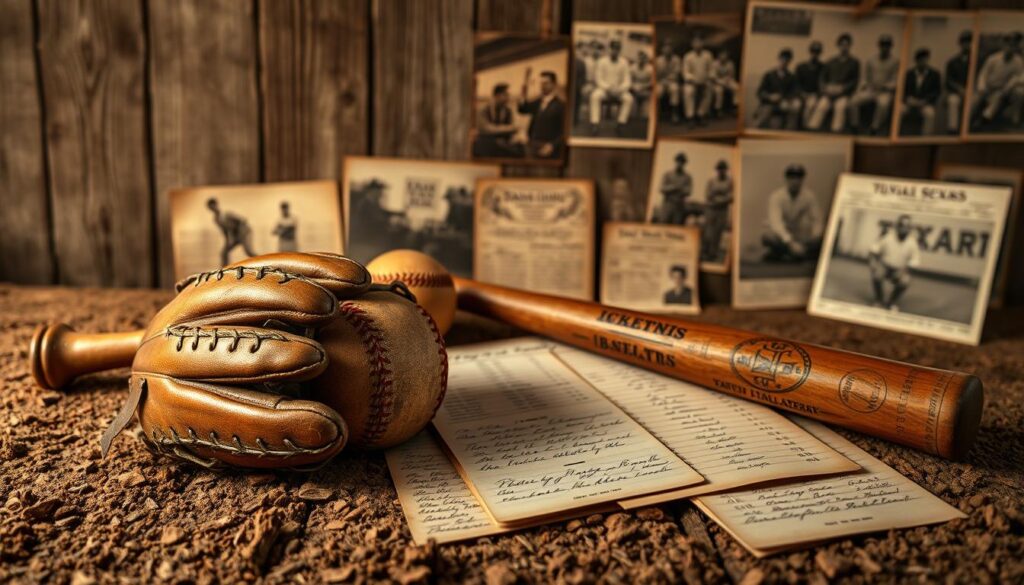
The .340 batting average is a number that speaks volumes. It tells us about Countryman’s skill but not the swing or the cheers. This is the first type of evidence we find: numbers in old records.
Countryman is buried in Lindenwood Cemetery in Illinois, without any mention of baseball. William “Billy” Weckbecker is in Hampton National Cemetery in Virginia, honored for his military service, not his baseball.
These gravesites show a historical irony. The men are remembered for their military service, not their baseball careers. It’s as if their baseball achievements were secrets.
The most intriguing artifacts are the paper trails. We find errors in census records and patent documents. A soldier’s claim for disability is another example.
These aren’t trophies but clues to the past. They show how history is often preserved by chance. It’s like solving a detective story with official documents.
What do these artifacts represent?
- Record books: The official records of athletic achievements
- Gravesites: The final resting places that tell selective stories
- Census errors: The human mistakes that create alternate identities
- Patent documents: The post-baseball attempts at entrepreneurship
- Pension files: The government’s record of service and need
Each type of artifact reveals a different side of these 19th-century baseball lives. Record books show the public athlete. Gravesites reveal the private person. Census records show the household member. Patents show the inventor. Pension files show the veteran.
This fragmentation is telling. In the past, before sports memorabilia became big, athletes’ lives were recorded in various ways. Their baseball feats were just one part of their story.
The survival of these artifacts seems random. Why did some documents survive while others didn’t? It’s a mystery.
This suggests that our understanding of 19th-century baseball history is based on luck as much as talent. The athletes we remember today might be those whose records were lucky enough to survive.
There’s a melancholy beauty to these fragments. We have Countryman’s batting average but not the sound of his bat. We have Weckbecker’s military honors but not his speed on the basepaths. These are shadows on a cave wall.
Yet, these shadows are what we have. They challenge us to imagine the athletes behind the numbers and signatures. The artifacts don’t give us everything, but they give us enough to start painting a picture.
This is what researching 19th-century baseball is like. It’s not about finding trophies in attics. It’s about studying microfilm, deciphering handwriting, and following misspelled names. The joy is in the discovery, not the object itself.
The surviving evidence shows us that history isn’t always about the highlights. It’s about the pension application, the business failure, or the clerical error. These artifacts preserve the whole life, not just the athletic chapter.
They remind us that 19th-century baseball players were complex individuals. Their careers before and after baseball are often documented more thoroughly than their athletic achievements.
In the end, these fragments create a mosaic. Each piece is incomplete alone, but together they form a recognizable image of a time, a place, and a game that was finding its identity.
How Their Legacy Persists
You won’t find bronze statues of these men outside modern ballparks. The legacy of Texas pioneers like Countryman, Weckbecker, and McIver isn’t carved in stone. It’s coded into the game’s operating system here.
Every time a local kid gets a brief call-up to the majors—that “cup of coffee” before returning to Round Rock—Otto McIver’s ghost gets a nod. The player-manager negotiating his own contract? That’s Weckbecker’s hustle. The wealthy local businessman whose team is both civic pride and financial headache? Charles Countryman perfected that role a century ago.
These Texas pioneers established the archetypes. They proved baseball here wasn’t just a sport. It was a social experiment, an economic venture, and a cultural thread. Their stories—the rise, the fall, the gritty travel—are our foundational myths. We remember them not because they were the best players, but because they were the first to navigate the messy intersection of sport, business, and Texas identity.
Their persistence is simple. We’re telling their stories. We’re trying to understand the flawed, fascinating men who played for love, money, or just a way out of town. They built the human substrate upon which Nolan Ryan and later legends would stand. The DNA they left behind? It’s in every minor league bus ride, every local ownership debate, and every Texas kid dreaming of the show.